
NBN pits and conduit: a plain guide for developers
Which pit types NBN allows, what each conduit size is for, how many conduits each pit can take, and the clearances that decide where pits can go.
Reviewed 14 October 2026 against NBN-TE-CTO-194 Revision 13.0
In short: NBN pit and pipe uses white PVC conduit in three sizes. P100 and P50 run along and across the street, and P20 runs from a pit to each house. Pits come in a handful of standard sizes, from the small Type 2 to a manhole, and each size has a fixed limit on how many conduits can enter each end. Pits must stay clear of transformers, poles, driveways and kerbs.
Conduit sizes and what they do
| Size | Main uses |
|---|---|
| P100 (100 mm) | Distribution and local network conduit along streets, road crossings for the local network, service drop to vertical MDUs over 60 premises |
| P50 (50 mm) | Lateral conduits across streets, laneway crossings, lead-in to MDUs of 2 to 60 premises, internal networks in super lots of 4 to 24 premises |
| P20 (20 mm) | Service drop to each SDU premises and small commercial premises, lead-ins in super lots of three or fewer premises |
Every conduit carries a synthetic draw cord of at least 3 mm with a minimum breaking force of 90 kg, and is sealed at both ends.
NBN pit types
| Industry type | NBN use | Minimum internal size (mm) |
|---|---|---|
| Type 2 | Service drop access pit, for service drop fibre only | 490 × 150 × 500 deep |
| Type 5 | Service drop, boundary or fibre joint pit, between the local network and service drops | 510 × 290 × 540 deep |
| Type 6 | Local network connection pit | 1130 × 340 × 600 deep |
| Type 8 | Local network connection and distribution pit, for hauling and splicing | 1130 × 390 × 820 deep |
| Manhole | Distribution network manhole, larger conduit combinations and road projects | 2460 × 1100 × 1325 deep |
| Trafficable Type 5 | Laneways and commercial MDUs only, with a Class D lid | 510 × 290 × 540 deep |
Lids are concrete and no heavier than 38 kg, unless they are composite lids that meet the AS 3996 Class B rating. Pit risers are not allowed in new developments.
How many conduits each pit can take
NBN's standard sets the maximum combination of conduits that can enter each end of a pit. Each row below is one allowed combination. Conduits enter through the narrow ends only, at least 50 mm from internal corners and the pit floor, with at least 25 mm between ducts.
| Pit | P100 | P50 | P20 (lead-in) |
|---|---|---|---|
| Type 2 | 0 | 1 | 2 |
| Type 2 | 0 | 0 | 3 |
| Type 5 | 1 | 2 | 0 |
| Type 5 | 1 | 1 | 2 |
| Type 5 | 1 | 0 | 4 |
| Type 5 | 0 | 3 | 0 |
| Type 5 | 0 | 2 | 2 |
| Type 5 | 0 | 1 | 4 |
| Type 5 | 0 | 0 | 4 |
| Type 6 | 2 | 0 | 2 |
| Type 6 | 1 | 2 | 2 |
| Type 6 | 1 | 0 | 4 |
| Type 6 | 0 | 4 | 0 |
| Type 6 | 0 | 2 | 2 |
| Type 6 | 0 | 1 | 4 |
| Type 6 | 0 | 0 | 6 |
| Type 8 | 4 | 0 | 0 |
| Type 8 | 3 | 2 | 0 |
| Type 8 | 3 | 0 | 4 |
| Type 8 | 2 | 4 | 0 |
| Type 8 | 2 | 2 | 4 |
| Type 8 | 1 | 4 | 4 |
| Manhole | 6 | 0 | 0 |
| Manhole | 4 | 2 | 0 |
Summarised from NBN's published standard for general guidance. Always design to the current revision of NBN-TE-CTO-194.
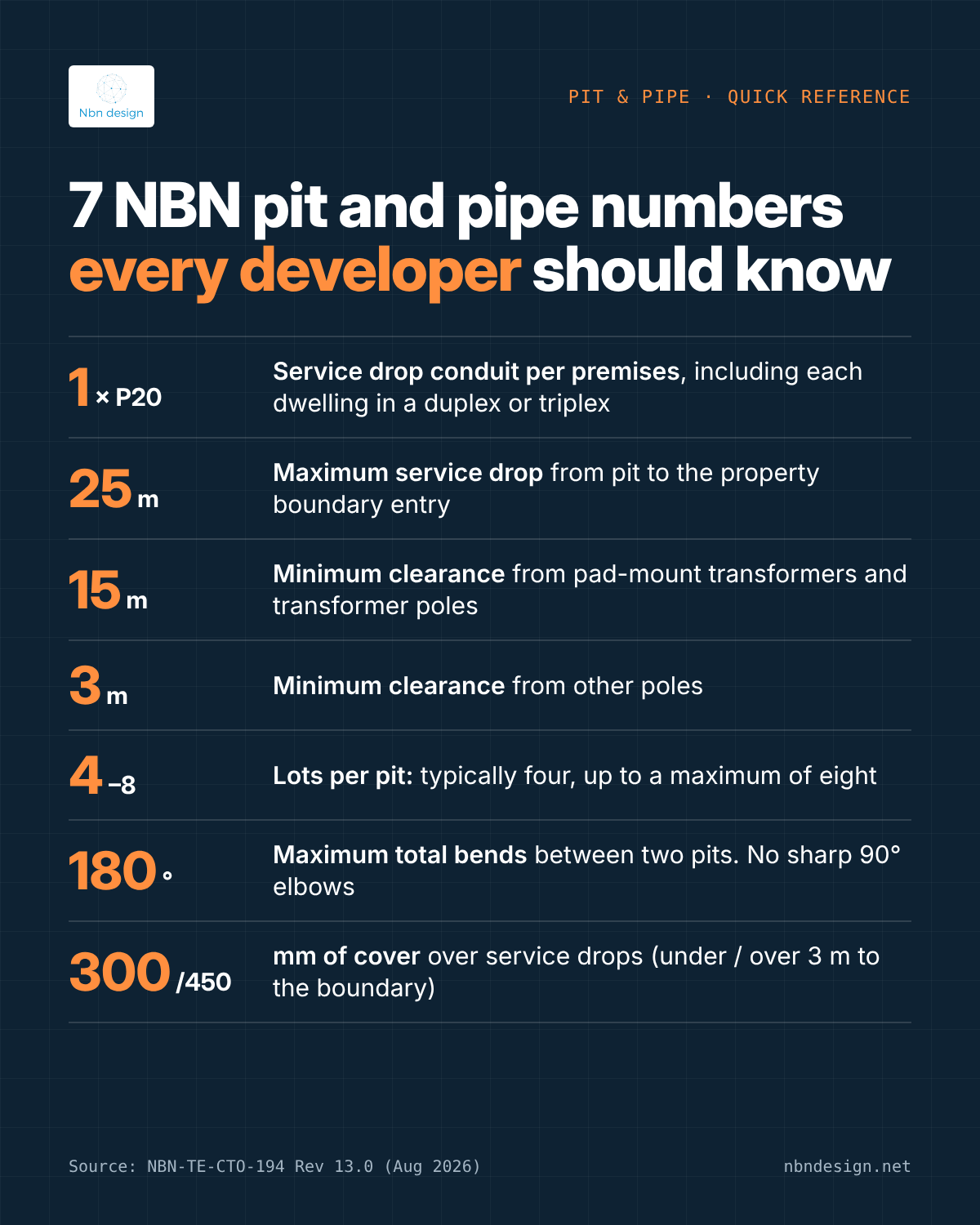
This table is why pit choice matters on a subdivision. A Type 5 boundary pit carrying one P100 through the street can only take four P20 service drops at that end. NBN's standard also allocates lots to a service drop or boundary pit in groups of typically four, up to eight.
Where pits can and cannot go
At least 15 m from pad-mounted transformers and poles with transformers.
At least 3 m from other poles.
Where practical, at least 1 m from the back of kerb, and long side offset 350 mm from the street-facing boundary.
Long side parallel to the property boundary or roadway.
Clear of driveways and proposed driveways. Where there is no alternative, a high strength pit is used.
Not in unmade carriageways, roadways, parking bays, swales, outside doorways or in hazardous areas.
Within 6.5 m of a street conduit change of direction of 90 degrees or more.
Bends and run lengths
- No more than 180 degrees of bends in total between two pits. If a route needs more, a pit goes in near the middle.
- Sharp 90 degree elbows are not allowed. P100 changes direction with 30 or 45 degree bends, or a sweeping 90 degree bend in the street network.
- Conduit runs longer than 250 m must pass through a pit.
- Service drops are limited to 25 m from pit to the property boundary entry.
Depth of cover
| Location | Minimum cover |
|---|---|
| Service drop, under 3 m from pit to boundary | 300 mm |
| Service drop, over 3 m from pit to boundary | 450 mm |
| Verge, footpaths and walkways | 450 mm |
| Road (not a state or territory road) | 600 mm |
| Road crossing | 800 to 1,200 mm typical |
Pit and conduit questions
What is a P20 conduit?
A 20 mm white PVC conduit. NBN uses it as the service drop from a pit to each single dwelling premises.
How close can an NBN pit be to a transformer?
NBN's standard requires pits to be at least 15 m from pad-mounted transformers and poles with transformers.
How many P20 conduits fit in a Type 5 pit?
Up to four at each end, when no P100 or only one P100 or P50 enters that end. Fewer fit when larger conduits are present.
How deep does NBN conduit need to be?
Service drops need 300 mm of cover when the run is under 3 m and 450 mm when longer. Verge conduit needs 450 mm and conduit under roads needs 600 mm.
Read the standard itself: NBN pit and pipe guides and standards.